Smurfit WestRock Agentic AI–Powered
Enterprise Data Discovery & Automation
Executive Summary
Smurfit WestRock, a global leader in sustainable paper-based packaging, operates a highly complex enterprise data ecosystem spanning manufacturing, logistics, supply planning, inventory, and financial reporting across more than 30 countries. While the organization had invested significantly in cloud platforms and enterprise data lakes, access to actionable insights remained slow, manual, and dependent on specialized technical teams.
To address these challenges, Smurfit WestRock partnered with Soulax to design and implement an Agentic AI–powered Enterprise Data Discovery and Automation platform built natively on AWS. The solution leverages Amazon Bedrock and a multi- agent AI architecture to enable natural language querying, automated SQL generation, intelligent schema navigation, and source-to-target mapping automation.
What previously required hours of manual effort by data analysts can now be accomplished in seconds through an intelligent AI “digital analyst.” The solution delivers measurable productivity gains, reduces operational bottlenecks, and establishes a scalable AI foundation aligned with Smurfit WestRock’s long-term digital transformation strategy.
The Challenge: Manual Inefficiency at Enterprise Scale
Background and Initial Problem
Smurfit WestRock manages one of the most distributed and data-intensive environments in the packaging and supply chain industry. Data is generated and consumed across hundreds of facilities and multiple enterprise platforms, including legacy systems mirrored into the Enterprise Data Lake (EDL), supply planning platforms such as O9, and metadata repositories such as AWS Glue and Informatica.
Despite modern infrastructure, business users and analysts struggled to efficiently locate, interpret, and query data. Accessing insights required deep schema knowledge, manual SQL development, and frequent back-and-forth with IT teams.
Pain Points
- Manual SQL Development
Analysts spent 10–15 minutes per query, often iterating multiple times due to incorrect joins or missing context. - Fragmented Metadata and Schema Complexity
Business meaning was not consistently captured across tables, making schema discovery slow and error-prone. - Source-to-Target Mapping Bottlenecks
Data mapping was maintained manually using spreadsheets, taking 3–5 hours per mapping set and relying heavily on tribal knowledge. - High Dependency on Specialized Talent
Business users depended on senior analysts and data engineers, limiting scalability and slowing decision cycles. - Delayed Insights for Planning Systems
Supporting planning platforms like O9 required time-consuming manual traceability across upstream data sources.
Business Impact
These inefficiencies resulted in delayed decision-making, increased operational costs, and reduced agility. Analysts spent disproportionate time on repetitive tasks instead of higher-value analysis, while business teams experienced long turnaround times for even basic data questions.
The Solution: Multi-Agent AI Automation
To address these challenges, Soulax designed and implemented an Agentic AI–driven data automation platform using AWS-native services. The solution acts as a conversational AI analyst capable of understanding enterprise data context, reasoning across schemas, and autonomously executing complex data tasks.
Key capabilities include:
- Natural Language Data Access
Business users ask questions in plain English without writing SQL. - Automated SQL Generation and Self-Correction
AI agents generate, validate, and iteratively correct SQL queries executed via Amazon Athena. - Semantic Schema Understanding
Metadata from AWS Glue and Informatica is embedded and indexed to provide contextual grounding. - Source-to-Target Mapping Automation
AI agents recommend field-level mappings using semantic similarity and business context. - On-Demand Analytics and Visualization
Tabular results and visual summaries are generated dynamically through a conversational interface
The system reduces manual effort, improves accuracy, and enables true self-service analytics at enterprise scale.
Core Innovation: Agentic AI Framework
The core innovation is a multi-agent AI architecture orchestrated through Amazon Bedrock. Instead of relying on a single large model, the solution decomposes tasks into specialized agents that collaborate through shared context and memory.
- Execution Agent (Amazon Bedrock – Nova Lite)
Optimized for fast, cost-efficient SQL generation and query execution. - Reasoning and Mapping Agent (Amazon Bedrock – Claude Sonnet 4)
Provides deep semantic understanding, join reasoning, and source-to-target mapping recommendations. - Schema and Metadata Embedding Agent (Titan Embeddings)
Converts metadata into vector embeddings for semantic retrieval. - Context Retrieval Agent (Amazon OpenSearch)
Supplies relevant schema and business context to ground AI responses.
This agentic design enables accuracy, explainability, and continuous improvement.
System Architecture
High-Level Architecture Overview
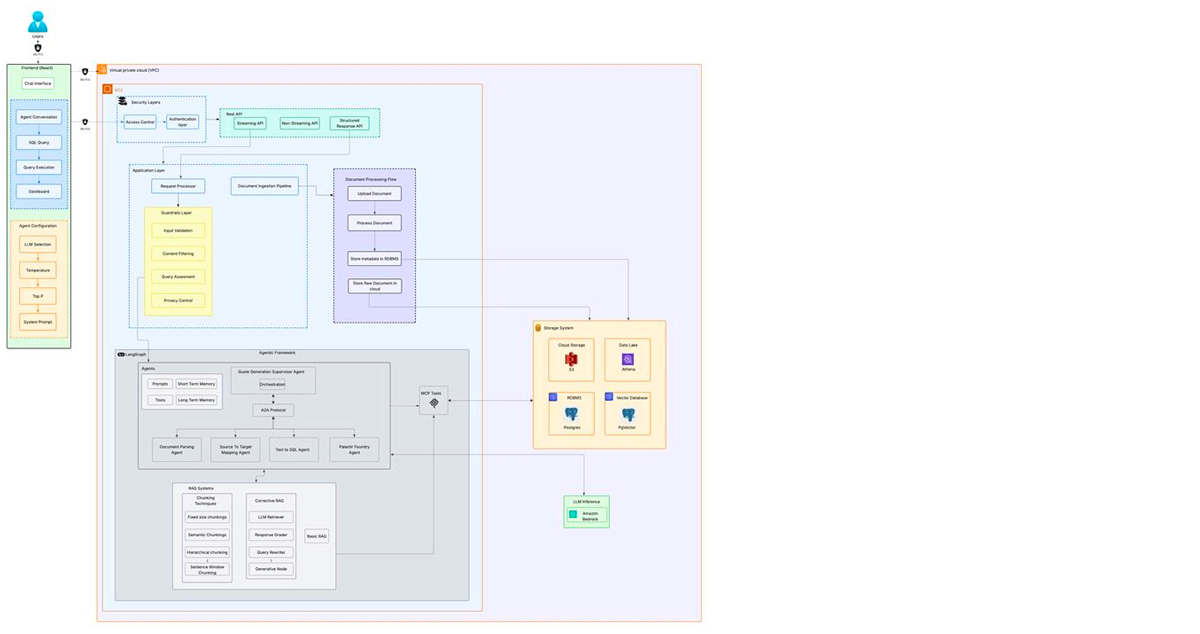
The solution is deployed within a secure AWS Virtual Private Cloud (VPC) and follows a layered, agent-driven architecture that enables secure, scalable, and governed enterprise data automation.
Business users interact with the system through a web-based conversational interface, which supports chat-based querying, dashboard visualization, and configuration of agent behaviour. All user interactions enter the platform through secured APIs and are processed by an Agentic AI framework that orchestrates multiple specialized agents to fulfill each request.
At a high level, the architecture is composed of:
- Frontend & User Interaction Layer
- Security and API Layer
- Application and Guardrails Layer
- Agentic AI Framework
- RAG (Retrieval-Augmented Generation) System
- Enterprise Data & Storage Systems
- LLM Inference Layer
This modular design ensures separation of concerns, strong governance, and the ability to independently evolve models, agents, and data sources.
Agentic AI Framework
At the core of the system is an Agentic AI Framework that orchestrates multiple specialized agents using a central Query Orchestration Manager Agent.
Each agent is purpose-built and operates with shared context, memory, and tools:
- Document Parsing Agent
Extracts and structures information from uploaded documents - Source-to-Target Mapping Agent
Recommends semantic field mappings across systems - SQL Generation Agent
Generates and refines SQL queries - Pattern Finder Agent
Identifies trends, anomalies, and insights in query results
- Short-term and long-term memory
- Tool invocation via MCP (Model Context Protocol) tools
- Structured coordination through an agent orchestration layer
This design allows complex enterprise tasks to be decomposed, reasoned over, and executed autonomously.
AWS Services Deployed
a. Compute and Orchestration
Each agent is purpose-built and operates with shared context, memory, and tools:
- Amazon Bedrock
Hosts and serves foundation models used by the agent framework, enabling secure, managed LLM inference without operating model infrastructure. - AWS Lambda / Container-based Services (ECS/EKS as applicable)
Execute backend services, agent workflows, request processing, and orchestration logic. - AWS VPC
Provides network isolation for all application components, ensuring secure communication between services.
b. Storage and Data Management
- Amazon S3
Acts as the primary object storage for uploaded documents, processed artifacts, embeddings, and logs.
- Amazon Athena
Serves as the SQL execution engine for AI-generated queries against enterprise data lakes. - Relational Databases (Amazon RDS / Aurora)
Store structured metadata, application state, agent outputs, and audit information.
c. AI and Machine Learning
- Amazon Bedrock
Provides access to multiple foundation models for:
– SQL generation
– Semantic reasoning
– Mapping recommendations
– Natural language responses - Embedding Models (via Bedrock) – Nova Premier
Used to generate vector embeddings for metadata, documents, and schema elements.
d. Search and Retrieval
- Vector Search Engine (Amazon OpenSearch)
Stores embeddings and powers semantic search and RAG retrieval across documents, metadata, and schemas.
e. Security and Governance
- AWS IAM
Manages fine-grained access control for users, agents, and services. - AWS KMS
Encrypts data at rest and in transit. - AWS CloudTrail
Provides audit logging for all API calls and data access. - AWS CloudWatch
Monitors application health, agent performance, latency, and error rates.
f. Integration and APIs
- Secure REST APIs
Enable frontend communication, streaming responses, and structured outputs. - MCP Tools Integration
Allows agents to safely invoke t
Results and Impact – Early Outcomes
Rather than deploying isolated AI features, Smurfit WestRock and Soulax adopted a platform-first, agentic architecture designed for extensibility and governance. The approach focused on:
- The Agentic AI platform was successfully deployed into production and is currently being used by a controlled group of analysts and business users.
- Query latency was significantly reduced, with end-to-end AI-assisted query execution completing in under one minute, compared to ten to fifteen minutes using the previous manual process.
- Initial AI responses are returned within seconds, enabling rapid iteration and conversational data exploration.
- Early accuracy results are positive, with automated query correction and validation reducing the need for repeated analyst intervention. Accuracy tuning is ongoing using enterprise metadata and user feedback.
- Analyst productivity increased, as users were able to complete multiple queries in the time previously required for a single manual query, without additional staffing.
- Early cost metrics confirmed low and predictable per-query costs using serverless AWS services and Amazon Bedrock, validating the scalability of the solution.
- User adoption met initial pilot targets, with qualitative feedback highlighting faster access to insights, improved usability, and reduced dependency on IT and data engineering teams.
- The first month of production use validated the Agentic AI architecture, security controls, and AWS-based deployment as production-ready.
This strategy ensured immediate ROI while creating a long-term AI foundation.
Screenshots