
Finloc automated its most time-intensive bottleneck—PPSA and RDPRM registration searches and waiver generation. Multi-agent AI now extracts data, matches records, and generates compliant documents at unprecedented speed.

Finloc, a financial services organization specializing in equipment financing and lien management, faced significant operational challenges in processing RDPRM (Registrar of Disputes and Personal Property Registry of Manitoba) and PPSA (Personal Property Securities Act) registration searches and waiver generation. What once required days of manual labor by specialized employees could now be accomplished in minutes through an intelligent, multi-agent AI automation system. This case study demonstrates how Finloc transformed its most time-consuming operational bottleneck into a competitive advantage through agentic AI architecture and cloud-based infrastructure.
Finloc’s core business involves securing and managing liens on equipment assets across multiple Canadian provinces. The process of searching provincial registration databases (PPSA and RDPRM), analyzing complex multi-page PDF documents, extracting relevant lien information, and generating compliant waiver and release documentation was entirely manual.
These inefficiencies translated directly to poor customer experience and operational strain. Customers expecting quick turnaround times were disappointed, and the finance team was constantly firefighting processing delays rather than focusing on strategic growth initiatives.
To significantly improve efficiency and reduce errors in manual registration search and waiver processing, Soulax proposed an automation solution. This solution will deliver faster customer responses, higher accuracy, less manual work and duplication, and a significant reduction in process-related frustrations and errors. The automated workflow will route tasks appropriately and provide real-time status updates, optimizing process times to minutes instead of days.
Leveraging an Agentic AI architecture for its scalability and flexibility, Soulax’s solution automates these key aspects:
Rather than building isolated point solutions, Finloc and Soulax designed a scalable, multi-agent system architecture capable of handling not just registration searches and waivers, but any future business process automation needs. This forward-looking approach provided immediate ROI while establishing a platform for continuous expansion.
The solution leverages specialized AI agents, each with defined responsibilities, orchestrated by a central manager agent. This architecture provides both immediate business value and long-term flexibility.
High-Level Architecture Overview
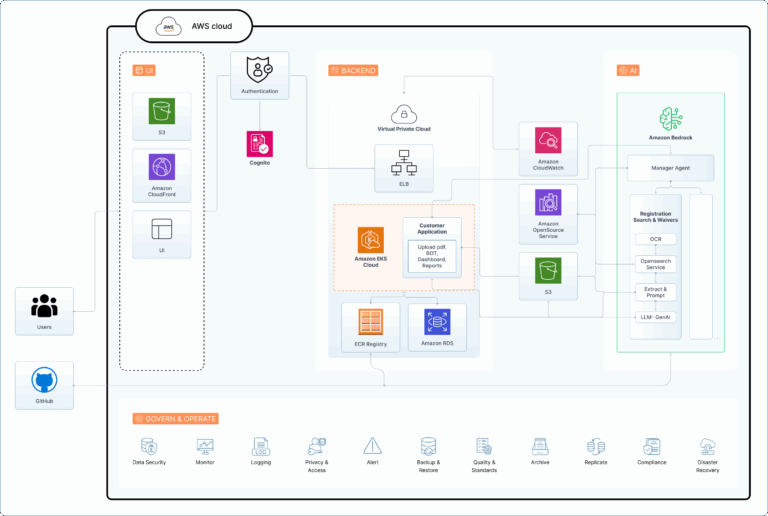
Amazon EKS/ECS
Hosts containerized application components (APIs, backend services, agent workflows) with auto-scaling capabilities to handle variable request volumes. Ensures high availability and efficient resource utilization across the multi- agent system.
AWS Lambda
Powers event-driven workflows for document processing triggers and asynchronous task handling, reducing infrastructure overhead for sporadic processing jobs.
Amazon S3
Central repository for all original and processed documents. Provides durable, scalable storage with versioning and lifecycle policies for compliance retention requirements. Integrates with CloudTrail for access logging and audit trails.
Amazon RDS (PostgreSQL)
Relational database storing structured data including extracted registration details, processing metrics, audit logs, and user activity. Supports real-time dashboards and historical trend analysis. Multi-AZ deployment ensures high availability.
Amazon OpenSearch
Enables efficient full-text search and indexing of documents and extracted content. Powers the search functionality for users to query historical registrations and waivers. Supports complex queries for compliance investigations.
Amazon Bedrock
Provides access to foundational AI models from Anthropic (Claude), enabling sophisticated text generation for document creation without managing separate LLM infrastructure. Future-proofs the solution for emerging model capabilities.
AWS Textract
Extracts text from PDF and image documents with high accuracy. Handles various document layouts and maintains spatial relationships for complex forms.
Amazon SageMaker
Platform for fine-tuning OCR and NLP models on Finloc-specific document samples. Continuously improves accuracy as the system processes more documents.
LangGraph Framework
Orchestrates multi-agent workflows, representing agent interactions as graphs. Provides modularity and fine-grained control over complex agent interactions and state management.
Amazon CloudWatch
Comprehensive monitoring across all AWS services. Tracks agent performance, API latency, error rates, and resource utilization. Generates real- time alerts for anomalies and provides centralized logging for all system components.
AWS X-Ray
Traces requests through the multi-agent system to identify bottlenecks and optimize performance. Visualizes service interactions and latency patterns.
AWS Secrets Manager
Securely manages credentials for provincial databases, Prextra integration, and external LLM APIs.
AWS KMS
Encrypts sensitive data at rest and in transit, ensuring compliance with financial services security requirements.
Prextra Integration
Custom API connectors facilitate seamless data transmission to Finloc’s existing ERP system with transformation and validation logic.
This strategy ensured immediate ROI while creating a long-term AI foundation.
The modular multi-agent architecture has established a reusable platform for future automation initiatives. Finloc can now leverage the same framework for additional use cases including insurance processing, equipment appraisal automation, and other document-intensive workflows, with significantly reduced development time and effort.
Screenshot 1: Finloc AI Operations Dashboard, a centralized workflow view where lien searches progress through review, correction, approval, payout, and closure stages, providing users with real-time visibility and control over each case.

Screenshot 2: AI model analysis view, where the system transparently explains each step of document interpretation—identifying document type, extracting key fields, validating data, and assembling the final structured JSON output. It provides users with confidence and auditability by clearly showing how AI reasoning and extraction decisions are made before downstream workflows proceed.
Screenshot 3: Lien Summary view, presenting a concise, decision-ready snapshot of search results, waiver requirements, payout status, and lien discharge confirmation. It enables reviewers to quickly assess outcomes across registration, unit, and owner searches before proceeding with approval, waiver, or payout actions.