SVARUPA – GENAI POWERED CHATBOT
Executive Summary
Svarupa is a non-profit knowledge organization that manages large volumes of complex, unstructured documents and reference materials. To improve access, usability, and analytical depth of this content, Svarupa partnered with Soulax to implement an AI-powered knowledge assistant based on an Agentic AI architecture using Amazon Bedrock.
The solution enables users to ask natural-language questions over extensive document collections and receive contextually grounded, traceable, and policy-compliant responses. By combining Amazon Bedrock foundation models, Bedrock Knowledge Bases, and multi-agent orchestration, Svarupa established a scalable and cost-efficient platform capable of supporting advanced knowledge exploration and future expansion.
The Challenge: Manual Inefficiency at Enterprise Scale
Background and Initial Problem
Svarupa maintains a continuously growing corpus of documents in multiple formats, including PDFs, word-processing files, and scanned content. These documents are enriched with metadata and expert annotations, but accessing relevant information required significant manual effort.
Users faced challenges when attempting to:
- Locate relevant information across large document sets
- Correlate related content across different documents
- Understand context without manually reviewing source material
- Perform advanced queries beyond keyword-based search
As document volumes and user expectations increased, traditional search and manual workflows became insufficient.
Pain Points
- Manual discovery effort
Users relied on keyword searches and document-by-document review - Fragmented knowledge
Information was distributed across formats and repositories - Limited semantic understanding
Conventional search lacked contextual relevance - High processing cost
Large document collections were expensive to analyze repeatedly - Governance requirements
AI responses needed to be grounded, explainable, and controlled
Business Impact
These limitations restricted the platform’s ability to scale knowledge access, reduced user productivity, and constrained the organization’s ability to introduce more advanced analytical capabilities.
The Solution: Agentic AI Knowledge Platform
To address Svarupa’s challenges in accessing and reasoning over large, heterogeneous document collections, Soulax implemented an Agentic AI knowledge assistant using Amazon Bedrock, Bedrock Knowledge Bases, and a multi-agent orchestration layer.
The solution focuses on three core use-case requirements:- Ingest and structure large volumes of unstructured documents
- Enable accurate, explainable question answering over those documents
- Support complex, multi-step queries that require reasoning across sources
Svarupa operates at significant scale. The solution is designed to support:- Tri-lingual interaction (English, Hindi, Sanskrit) with expansion to 15 total languages
- 2000+ structured knowledge collections
- 10M+ structured and semi-structured knowledge documents
- Keyword, semantic, and hybrid search
- Text-to-text user interactions
- Multi-agent autonomous reasoning
- Responsible AI controls embedded directly into AI execution
1. Large-Scale Knowledge Ingestion and Structuring
Svarupa’s content spans millions of documents in multiple formats, including PDFs,
text files, and scanned sources. The solution includes a document intelligence
pipeline that:
- Extracts text and layout information from documents using OCR and preprocessing
- Segments documents into semantically meaningful chunks
- Enriches each chunk with AI-generated metadata such as summaries, keywords, and contextual signals
- Processes content in bulk using Amazon Bedrock batch inference, enabling cost-efficient enrichment at scale
2. Multilingual, Multi-Modal Knowledge Access
The Svarupa AI assistant supports both text-based interactions, allowing users to engage with the platform in the mode most natural to them.
Key capabilities include:
- Natural-language question answering across multiple languages
- Seamless switching between languages within a conversation
- Support for text-to-text interactions
- Consistent response structure regardless of input modality
This enables broad accessibility while maintaining consistent accuracy and grounding across interaction types.
3. Knowledge Base–Driven Question Answering
For each user query, the system follows a structured execution flow:
- The query is analyzed to determine intent, scope, and language
- Relevant context is retrieved from Bedrock Knowledge Bases using semantic, keyword, or hybrid search
- Retrieved content is tightly bound to response generation to ensure grounding and traceability
- The system synthesizes concise, structured answers rather than returning raw search results
This approach replaces manual document exploration with direct, explainable answers backed by source content.
4. Agentic Reasoning for Complex Queries
Many Svarupa use cases require reasoning across multiple documents, collections, or hierarchies. To address this, the solution uses a multi-agent autonomous reasoning model.
Each query is handled by a coordinated set of agents:
- Orchestrator Agent
Interprets user intent and plans execution steps
- Retrieval Agent
Queries Bedrock Knowledge Bases using appropriate retrieval strategies
- Analysis Agent
Correlates, compares, and synthesizes information across sources
- Validation Agent
Verifies grounding, completeness, and response confidence
Agents execute tasks in parallel where possible, enabling fast responses while maintaining deterministic, auditable execution paths.
5. Responsible AI Embedded into Execution
Responsible AI is not treated as an afterthought. It is embedded directly into the query lifecycle:
- Retrieved context is validated before response generation
- Generated responses are checked for grounding, relevance, and policy compliance
- Low-confidence or incomplete answers are handled safely
- Security, access control, and observability are enforced using AWS-native services
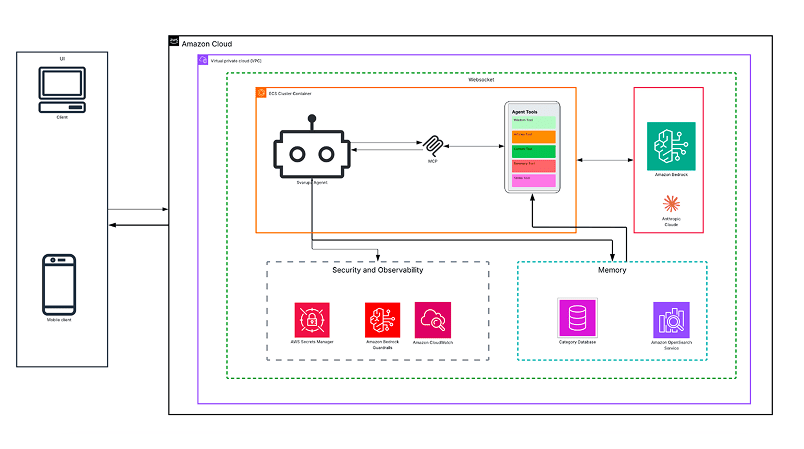
System Architecture
High-Level Architecture Overview
Core AWS Stack
| Category |
AWS Services |
| AI Agents |
Amazon Bedrock (Claude 3.7 Sonnet, Claude 3.5 Haiku) |
| Responsible AI |
Amazon Bedrock Guardrails |
| Long-Memory |
Amazon OpenSearch Service |
| Short-Memory |
Amazon RDS (MySQL, Multi-AZ) |
| Caching |
Amazon ElastiCache (Redis) |
| Storage |
Amazon S3 |
| Compute |
AWS ECS (Fargate) |
| Networking |
Application Load Balancer |
| Security |
AWS IAM, AWS Secrets Manager |
| Monitoring |
Amazon CloudWatch |
Specialized Agent Architecture
Orchestrator Agent
- Interprets user intent
- Plans execution steps
- Coordinates all downstream agents
- Synthesizes the final response
Retrieval Agent
- Queries Amazon Bedrock Knowledge Bases
- Performs semantic and hybrid search
- Retrieves relevant document context
Analysis Agent
- Interprets retrieved content
- Normalises and summarises information
- Resolves relationships across documents
Validation Agent
- Verifies grounding and completeness
- Applies policy and safety checks
- Flags low-confidence responses
Memory Agent
- Maintains conversational context
- Supports short-term and long-term memory
| Tools | AWS Services |
|---|
| Content Agent | Mantras, deities, rishis, meters |
| Summary Agent | Meanings, interpretations |
| Terms Agent | Sanskrit linguistics & morphology |
| Key Sukta Agent | Canonical hymn knowledge |
| Wisdom Agent | Spiritual teachings |
| Orchestrator Agent | Scholarly references |
| Compute | Orchestrate the use question, and synthesis the final response |
AWS Services Deployed
Compute and Orchestration
- AWS ECS (Fargate) for agent services and orchestration
- AWS Lambda for event-driven ingestion and processing
Storage and Data Management
- Amazon S3 for document storage and processing artifacts
- Amazon OpenSearch Service for indexed long-term knowledge memory
AI and Machine Learning
- Amazon Bedrock for foundation model inference
- Amazon Bedrock Knowledge Bases for managed retrieval-augmented generation
- Bedrock Batch Inference for large-scale, cost-efficient document enrichment
Monitoring and Logging
- Amazon CloudWatch for performance and cost monitoring
- AWS IAM and Secrets Manager for secure access control
- Encryption at rest and in transit across all data paths
Results and Impact – Early Outcomes
Quantified Improvements
- 30–70% reduction in AI processing costs using batch inference and prompt optimisation
- Sub-2 second latency for cached responses
- Under 5 seconds latency for cold, multi-agent reasoning
- 95%+ query understanding accuracy
- 50%+ reduction in token usage through structured prompting and caching
Operational Benefits
- Scalable ingestion and analysis of large document collections
- Reduced operational complexity by using managed AWS services
- Improved reliability through deterministic agent workflows
- Built-in governance and observability
Strategic Value
- Reusable agentic framework for additional knowledge domains
- Reference implementation for enterprise-grade Agentic AI on AWS
- Foundation for future multimodal and multilingual expansion