Leveraging IoT and Big Data for Sustainable Supply Chain Transformation
In an era where digital transformation is not just an

Building Scalable Cloud Solutions
Transform Transportation & Logistics, Supply Chain Management, and Manufacturing workflows with cloud applications powered by Agentic AI—designed for agility, automation, and growth.”
Cloud computing revolutionized the way modern businesses are done, with an ability to offer unprecedented scalability, flexibility, and speed like no other. Soulax augments enterprises with expertise in building and operating Cloud Native Applications in AWS. Let’s dive into some of the architectural best practices for agility, security, and costs.
The resources of cloud-native scale automatically up or down based on the demand, in a manner such that maximum performance and utilization of the resources are attained without being capped by manually provisioned resources (compute, memory, storage, network).
A cloud-native architecture allows a developer to use managed services and microservices such that the business moves with pace in terms of innovation, at a faster cadence for update deployment and focuses on creating value rather than managing infrastructure.
Realized due to an on-demand use of cloud resources by an organization, hence avoiding the bulky overhead costs associated with maintaining excess infrastructure, which thereby also increases application performance.
Hyperscalers like Amazon Web Services (AWS) have multiple regions (data centers) where a repeatable design can be implemented to take new services to market. This enables all consumers of the application, from IoT devices and business users, to connect and derive value in a performant manner.
Building cloud-native applications from the ground up presents a whole new set of challenges: building security measures from the start, managing the complexity of distributed systems, and requiring highly specialized skills.
Integration of cloud applications into the existing tech stack is also a challenge for the enterprise. IT departments have to study the new technologies and the consequences of legacy system integrations.
There is a significant skills gap in the organizations that causes friction in implementation times and operational efficiencies. The multifaceted considerations introduced by edge devices for manufacturing plants and IoT further exacerbate this issue (increasing the attack surface, software diversity, and latencies, among other factors).
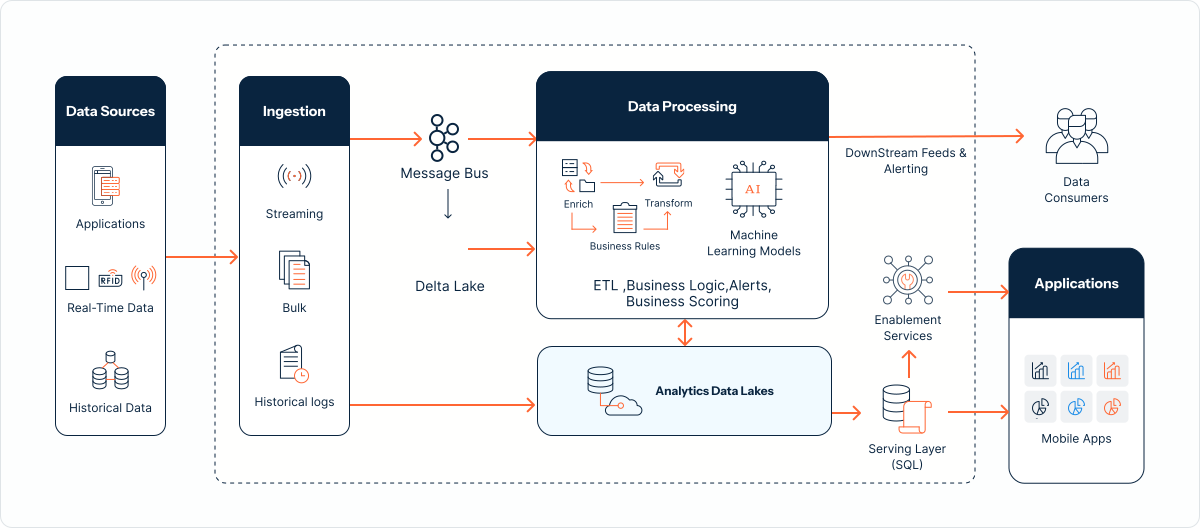
Amazon Elastic Kubernetes Service (EKS), S3, Amazon EMR and Kafka (ASK) have been used as building blocks for architecting robust cloud applications. This has armed the business with real-time decisionand new revenue streams. Soulax has also implemented data workflows allowing engineers to leverage containerized versions of ETL tools and manage them efficiently across distributed environments.
Soulax team is aware that our clients want to balance between cost and performance with cloud-native applications. So we offer a plethora of means and tools that help you to get the most value from spending yet maintain a high-performance level, including reserved instances and autoscaling policies.
AWS and other hyperscale providers follow a “Shared Responsibility Model”, which clearly states that you (the enterprise) are responsible for the security of your applications and data running in the cloud. Soulax has incorporated multiple levels of security into our architecture template to help customers achieve their goals more efficiently and in compliance with regulations.
A good cloud native strategy consists of assessing the existing infrastructure, pinning the areas of improvement, and drafting a step-by-step transformation plan. This approach will allow a smooth transition to a cloud-native ecosystem with maximization of the advantages and minimization of disruption.
We have helped our customers with the ability to overcome the pitfalls of cloud application development and open new horizons for growth and competitiveness.
A well-architected cloud native application on AWS would include core components such as auto-scaling, handling data pipelines, enforcing strong security controls, and live visibility with comprehensive monitoring.

In an era where digital transformation is not just an
In a bid to overhaul its supply and demand planning,


VOR use case outlines an automated process for retail order
Whether you’re looking to optimize operations, create new revenue streams, or enhance customer experiences, Soulax’s Enterprise IoT solutions can help you achieve your goals. Contact us to learn more and embark on your IoT transformation journey.